



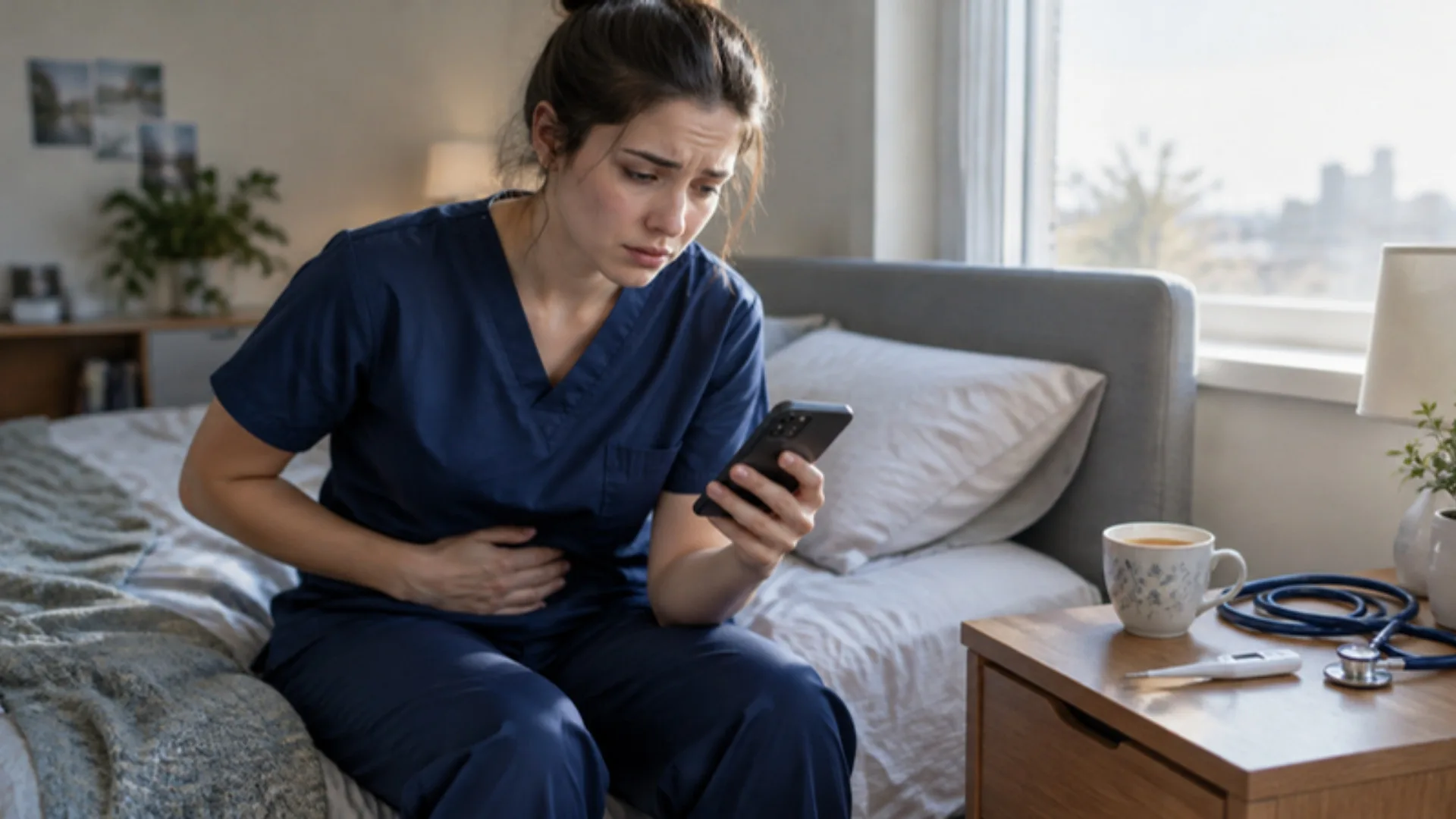
Imagine this: you’re a nursing student enrolled in a demanding clinical program, where you apply classroom learning in a healthcare setting. You’re required to attend supervised, hands-on learning sessions in a clinic or hospital. You’ve fallen sick and need to take time off to recover.
So, you dial the number you were given for situations like this, making sure to call before the deadline. However, you then receive a message asking you to share your live location so that the staff member who is supervising you can confirm your truthful location.
You are uncertain about what to do. A policy exists for moments like this, and you did what it states. But now you are being asked for something extra, something that is not in the policy.
This is a concern for many students in clinical programs. These students feel pressure to perform even when they are not well enough to function properly, because a missed shift can put their progression at risk. So, when a student applies for sick leave and is asked for a live location, what they are really being asked for is proof: “Prove that what you are saying is true.”
This guide covers what students in this situation can do: what they should check, what they should ask, and what they should put in writing. Please note that this is general information, not legal advice. The right answers depend on the student’s school, clinical program, and the state in which they are studying.
What Can a Student Do When They Followed the Sick Leave Policy but Are Asked for Live Location Proof?
Begin by Confirming That the Required Sick Leave Notification Procedure Was Followed
The first thing the student should do is open the handbook or clinical syllabus for their program and read the sick leave section line by line. Next, the student should write a short timeline of what they did, i.e., how they tried to follow the policy. It helps to write everything down and then review it as if it were someone else’s work, because this lets the student view the facts with a critical eye and be ready to respond to anyone else who applies that same scrutiny to the sick leave request.
For example, Maya, a nursing student, applies for sick leave and is asked to provide a live location. She reviews the formal sick leave policy and starts to build a timeline. She writes: “5:12 a.m., called the clinical instructor’s line; 5:14 a.m., emailed the same instructor; shift began at 7:00 a.m.” Next to each entry, Maya notes the policy language that her actions satisfied.
This is a good first step, and the student should complete it before replying to anyone, whether about a live location or anything else, because every step the student takes afterward depends on whether they complied with the policy in the first place. If the student finds a gap, such as a call that went to the wrong person, tracing their steps and writing out a timeline will reveal it immediately. The student can then be upfront with program staff, who will appreciate an honest and transparent approach.
Ask Program Staff to Identify the Written Requirement for Live Location Verification
Once the student has clearly established a timeline of events, they can move on to responding to program staff. If program staff have asked the student for live location verification in response to the sick leave request, the student should ask program staff, in writing, for the relevant part of the policy that requires it.
A student should do this because, when a request comes from someone in a supervisory role, students often accept it at face value, perceiving it as established and recognized practice. It is entirely possible that the live location is indeed a requirement under established policy. It is just as possible, however, that it is one staff member’s preference, which has never been written or established as formal policy.
An example response from the student could be: “Can you please point me to the section of the handbook or syllabus that requires live location confirmation? I just want to make sure I follow it correctly.”
The student’s response should be plain and matter of fact. Written this way, it is not an outright refusal to share their live location. It is simply a request to see the source of the rule, if it is indeed a rule, so that the student can be fully compliant.
If a section of the handbook requires sharing a live location, the student now knows what it says and can follow it to the letter. If no such section exists, the answer from program staff, or even the lack of one, becomes part of the written record of correspondence.
Request Clarification Before Providing Additional Personal Location Information
Before sending their live location to anyone, the student should consider the nature of the data being shared. Location data reveals a person’s whereabouts at a specific point in time, and it is hard to take back once it has been sent. It is highly sensitive information, as a shared location pin can reveal where someone slept, which clinic they visited, and who else lives at that location.
Therefore, before clinical students share location data with program staff, they should first ask a few specific questions:
- What exactly needs to be confirmed: the sickness or the student’s whereabouts?
- Is this live location verification a single check or ongoing sharing?
- Who will see this live location, and for how long?
While waiting for an answer to their earlier question about the handbook rule (“Can you please point me to the section of the handbook or syllabus that requires live location confirmation?”), the student should not remain silent. Instead, they should message the program staff member the same day and say something to the effect of “I’m happy to work with you on this, of course. I just have a few questions first.”
How Can the Student Demonstrate Compliance with the Sick Leave Policy?
The Student Should Review the Policy Actually Applicable on the Date of the Clinical Absence
Program handbooks are constantly revised, sometimes midyear or even between semesters. The version of the handbook that applies to a student at any given time may therefore not be the one that was in force on the day they called in sick.
For this reason, students should find the edition of the program handbook that applies on the date of their absence. They should check the handbook year, the course syllabus for that clinical rotation, and any site-specific rules that the placement hospital adds, and save a dated copy of each as a separate PDF for easy reference. Generally, the policy in effect on the date of the absence is the starting point for any dispute, though a school may argue otherwise.
If the handbook and syllabus say different things, the student should keep both and note the conflict.
Verify the Required Notification Method, Recipient, and Deadline
Most sick leave problems come down to three details: how the student notified program staff, who exactly the student notified, and when. For example, a sick leave policy might read: “Call, do not text, the clinical instructor directly at least two hours before the shift.” Each part of this sentence is a separate requirement: calling instead of texting; notifying the clinical instructor and no one else; and doing so at least two hours before the scheduled shift.
The student should check their sick leave notification against each requirement.
Phone Calls, Messages, Emails, and Clinical Reporting Systems
Clinical programs tend to differ on which modes of communication count as a sick leave notification. Some programs require a live voice call, while others accept anything from a voicemail or a text sent to a designated program phone number to an email or even an entry in a clinical placement tracking system. Many programs require two of the above.
If a student leaves a voicemail to notify program staff of their sick leave, they should find out whether the program’s policy allows it. If they sent a text, they should check whether it went to a number the program has designated or to the instructor’s personal phone.
Timestamped Evidence of Compliance with Notification Requirements
Timestamping communications is just as important as using written correspondence when creating a record.
The call log in most phones shows dialed numbers, the time of each call, and how long the call lasted. An email shows the time it was sent, who sent it, and to whom. Even a tracking system usually records an entry time.
Time logs from these modes of correspondence can be vital. Students should therefore screenshot each one with the date and time visible and, if their phone allows it, export the full call log.
Sharing a screenshot of a 45-second call to the instructor’s number at 5:12 a.m. is a stronger statement than simply saying that they called the instructor or relevant member of program staff at the time they were supposed to, as per policy.
Organize Communications Showing That the Student Reported the Absence Correctly
When gathering records of correspondence, the student should organize them carefully. Everything should go in one folder on their computer, or whatever device they are using to document communications, in order of date, with file names that begin with the date (ideal, as “sort by date” on a computer sometimes doesn’t work well). The records should include the student’s outgoing calls and messages, any replies from program staff, and the policy pages the student relied on.
Finally, the student should add a one-page timeline (e.g., in a Word document) that provides an overview of the correspondence. The original files should be kept too, not only screenshots, so the student can show where a message came from if anyone asks.
Do not edit or delete anything, including messages that sound frustrated. Program staff may later describe what happened differently than the student remembers it, so keeping a complete record is important. It is how the student can show the sequence without having to defend it or argue about it.
Determine Whether Any Other Documentation Was Required
In some clinical programs, sick leave policies ask for more than a call to notify program staff. Such policies may also require the student to provide, for example, a medical note after two missed days, a return-to-clinical form, or a short incident report. These are some of the most common examples of additional supporting documentation for sick leave.
For this reason, students should return to the sick leave notification section of their handbook and look only for any extra documentation that is required, as well as the deadlines for providing it. If the program’s policy does not ask for something, students generally have no obligation to produce it, even if someone suggests it.
On the other hand, if the program’s policy does ask for something and the student has not yet provided it, they should send it now. Sending it late, though not ideal, is still a smaller problem than not sending it at all.
Can Program Staff Require Live Location Proof After a Student Reports Being Sick?
Determine Whether Live Location Verification Is Addressed in the Published Policy
Earlier in this guide, the student was advised to ask program staff to point to the part of the handbook that says live location is required when sick leave is being notified. The guide then advised the student to look up the version of the ever-changing handbook that was actually in effect on the date of the absence. Both of these steps build toward this next one: looking at the handbook to verify that program staff are, in fact, quoting program policies accurately.
The student should search their program handbook, syllabus, and any clinical agreement they have been given for words like “location,” “whereabouts,” “verify,” “verification,” and “confirm.”
Written policies often contain broad language, such as a clause allowing the program to “verify the reason for an absence.” Program staff may argue that this sentence covers location sharing, but the student can argue that it does not. Neither argument is wrong, per se.
If nothing in the written program policy mentions location sharing, the student should say so in writing, calmly, and ask program staff how their request fits within the policy.
Ask Whether the Requirement Was Established Before or After the Absence
Even when a program’s policy is written in its handbook and is unambiguous, timing matters. Following a rule that is printed in the handbook, which a student may have acknowledged in August, is not the same as following a requirement that an instructor added in a midsemester email after another student’s absence.
For this reason, when a program imposes requirements about absences of any kind, students should ask program staff when the requirement was adopted, how the student body was told about it, and whether anything signed by a student covers it. The student should then check their own file for orientation acknowledgment forms and read what they actually say.
If a procedural requirement regarding absences was established after a student’s absence, the student should ask whether it applies to that absence. Programs sometimes apply new expectations to old events without considering whether doing so is fair.
Clarify the Purpose and Scope of the Requested Location Information
Clinical programs have an incentive to request live locations. These requests, and the pressure they place on students, can deter excessive or casual absences.
Programs have reasons to do this. Clinical placements are limited, and a no-show affects patient assignments and the program’s relationship with the clinical site. Needless to say, anyone in a teaching position, even faculty who teach healthcare students, has heard invented illnesses before. Clinical program staff who ask for a student’s live location are therefore under a great deal of pressure of their own, so their request probably comes from that pressure rather than from curiosity about the absent student’s personal life.
Consequently, the student should ask what the request is meant to confirm. If the answer is something like “that you are not at another job” or “that you are home,” that purpose can often be met more narrowly, and a narrow purpose does not justify a broad collection of student data.
One-Time Location Confirmation Versus Continuous Location Sharing
In matters of location sharing, it is also important to consider the type of location sharing itself. A single screenshot of a map showing a student’s location at a specific moment in time is a relatively small, perhaps even reasonable, disclosure. A live location shared for several hours, or even for the rest of the semester, is a massive overreach, because live locations can show every stop that the location-sharing party makes, including, for example, a pharmacy, a specialist, or a family member’s house.
Students should therefore ask which type of location data program staff is requesting, and for how long. If the request does not specify the nature and duration of the location data, the student’s reply should note this.
Access to, Retention of, and Handling of Personal Location Data
Students should remember that they have a right to their data and a right to have it kept safe, especially from overly broad disclosures. They should ask who will see the information they are sharing with program staff, especially location data; where it will be stored; how long it will be kept; and whether it can go to a clinical site or anyone else. If the staff’s answer is “we haven’t decided,” or something similar, that is a clear sign that the request for location data was made without its actual use being fully thought through.
This matters because it creates a legal wrinkle. Under the Family Educational Rights and Privacy Act (FERPA), records that are directly related to a student and maintained by the school are generally education records, and students can request to inspect them. The school must respond within a reasonable time, and no later than 45 days. Whether a particular screenshot or text thread counts depends on how the school keeps it, and that is not settled in any simple way.
Examine Whether the Request Is Consistent with Applicable Institutional Privacy Policies
When looking at the subject of this guide from a distance, one might wonder what all the fuss is about: a student asks for a day off, and their program staff ask them for a live location.
Even if one leaves aside the many issues here (e.g., the pressure the student feels to respond quickly, perhaps even to their own detriment, or a staff request that is not in line with written policy), one major issue remains: privacy. Location data is sensitive and private, and requesting it casually to verify an absence can be borderline intrusive, even if it is supported by program policy.
Students, however, have a legal right to privacy, and they should feel empowered to uphold it rather than feel that they must forgo it to comply with program policy.
Therefore, students should read their school’s privacy notice, student code of conduct, and any data or technology policy that they can find. Some schools have language about what personal data they collect from students and why. If program staff make a request that conflicts with the school’s own written policy, the student should note it and point it out.
When it comes to federal law, however, it is important to be realistic: FERPA governs how schools handle education records, but it does not speak to location requests directly, so do not expect it to settle this on its own.
Meanwhile, state privacy laws vary. Public institutions can face constitutional limits on monitoring, while private institutions might not, and how that applies to a request for location sharing is a question for a qualified lawyer.
What Alternative Documentation Can the Student Offer?
Ask Whether Existing Sick Leave Records Are Sufficient
After the steps above, the student should still consider alternative documentation before sharing location data. Call logs and emails, as already mentioned, carry timestamps that the student cannot alter, so they have provenance. The student should therefore first ask whether these are acceptable. The question can be put very plainly: “Do my call log and email satisfy the sick leave requirement for the date on which I was absent?”
The question sounds simple, which is what makes it effective: it forces a “yes” or a “no” from program staff, in writing. If the answer is “yes,” the location request has no remaining purpose, and the student can politely say so while sharing call logs and emails. If the answer is “no,” the student should ask why. Again, the response will be in writing, which is important.
Program staff can sometimes make additional requests without ever deciding whether the first set of records was enough. A simple question like the one above can make them decide.
Determine Whether a Medical Note Is Required Under the Applicable Policy
Some clinical programs ask for a note after a student misses one shift, whereas other programs wait until a second consecutive day off or a predetermined total number of absences in a given term.
Once again, the student should read their program policy for the relevant trigger. If a note is required, a telehealth visit on the day that the student is sick can often produce one quickly. The student should therefore ask the telehealth provider for a note stating that they were unable to attend on specific dates, and nothing more.
However, if no note is required, students do not need to offer one to make the location request go away.
Request Acceptance of Less Intrusive Verification Methods
Even when a student wishes to decline program staff’s request for a live location, they should consider asking whether staff will accept other verification methods. Once again, asking in writing not only maintains a written record but also demonstrates to staff that the student is cooperating and has concerns only about privacy. Other verification methods could include:
- A callback to the student’s phone at a time the program picks;
- A short video call with the student;
- A signed statement confirming the dates and reason for the student’s absence;
- A health provider’s note, if one exists;
- A one-time location confirmation limited to a single moment.
The student should take care when asking about these other methods by framing the message to program staff as an offer. An example message could be: “I’d like to meet the intent of this requirement. Would any of these alternative verification methods work? Please let me know.” A message like this signals to staff that the student is aware of the nature of the problem and, more importantly, is trying to solve it with them.
Keep Medical and Personal Information Limited to What Is Actually Required
Any time program staff ask a student what is wrong, most students end up providing a much more detailed explanation than necessary, volunteering an excessive amount of information. In most cases, a program’s policy asks students to report simply that they were ill, not to name their illness or the formal diagnosis from a healthcare provider.
Students should always provide the minimum possible information required by the program handbook. If it is not clear what the minimum is, the student should simply ask program staff. This is important because anything a student hands over goes into a file, and the student does not control who reads it.
There can be some legitimate exceptions that the student should consider. After all, clinical sites can have their own health-and-safety rules about certain contagious illnesses, so a program may need to know whether and when a student can return. If a student is applying for an absence because of a disease for which their clinical site has specific health-and-safety rules, the student should ask what information the rule requires and then provide only that information.
How Should the Student Respond if Staff Treat the Absence as a Policy Violation?
If program staff have decided to treat a student’s absence as a policy violation, the matter may be considered escalated, but the student’s process is broadly consistent with what this guide has outlined above.
Request a Written Explanation of the Alleged Violation
As this guide has emphasized throughout, obtaining and maintaining information in writing is vital.
For this reason, when a student is facing a verbal accusation, the first order of business is to remember that a verbal accusation is an allegation that cannot be answered properly, because nobody has agreed on what is being alleged, or even why it should be considered an allegation in the first place. Students should ask for a written statement that names the policy section, the date, and the conduct they are accused of violating.
As always, when wording such a request to program staff, simple language works best: “Please send me the specific policy section and the conduct you believe violates it, so I can respond accurately.”
After that, the student should give staff a reasonable deadline (e.g., five business days). A written statement fixes the allegation in place and keeps the conversation from shifting each time the student answers a point.
Distinguish Failure to Report an Absence from Refusal to Provide Additional Location Information
Programs in any school, whether healthcare-related or not, can sometimes merge two separate issues into one complaint when enforcing policies.
In the case this guide discusses, if a student fails to report an absence, this might break a written notification rule, but only that rule. Not providing program staff with a location pin, especially when no written rule in the handbook asks for it, is a different matter, and one that could validly be considered an overreach.
| Allegation | What the record would need to show | Your evidence |
|---|---|---|
| Failure to report the absence | A written notification rule that you did not meet | Call log, email, policy pages |
| Declining additional location sharing | A written requirement to share location, in force on the absence date | Your questions to staff, offered alternatives |
Students should take care with the words they use. If a student has asked questions and offered alternatives, the student did not refuse and should not use the word “refused” to describe their own actions.
Correct Any Inaccurate Attendance or Professionalism Records
If a student’s file says “no call/no show,” but their call log says otherwise, they should ask program staff to correct the entry. Under FERPA, a student who believes a record is inaccurate or misleading can ask the school to amend it, and the school must decide within a reasonable time. If it declines, it must tell the student about their right to a hearing.
This process is generally aimed at factual errors, such as a wrong date or a missing call, and not at a faculty member’s professional judgment. Students should understand this, attach their evidence, and be specific about which entry is wrong.
Preserve Communications and Submit a Factual Written Response
When writing their response, a student should imagine that a committee will read it, because it is entirely possible that one might. The response should be concise, ideally fitting on a single page, and should include:
- A dated timeline of what the student did;
- The policy language the student followed;
- What the student asked and what they offered;
- What the student is requesting now.
The student should leave out any opinions about staff members and any language that sounds like an accusation or is even remotely emotive. Additionally, the student should keep a copy of the response, as with all other correspondence, in their own private email (for example, by BCC’ing their private email address) rather than only on a school account that could be restricted. Under no circumstances should the student delete any texts, including ones they wish they had phrased differently.
What Should the Student Do if the Dispute Threatens Clinical Progression?
This is what most students in clinical programs fear when requesting something as simple as sick leave. However, the student should remain calm and follow procedure.
Identify the Program’s Complaint, Grievance, or Appeal Procedure
The student should try to find the procedure right away, before they even need it. It is usually in the handbook or on the student affairs page, and it says who hears the matter first and who hears it afterward.
As always, the student should pay attention to the deadlines mentioned in the policy, as they can be short, sometimes only a few business days from the date of a decision. Missing even one deadline can end the process, regardless of how strong the student’s evidence is.
If the student’s school has a student ombuds office, they should find out whether it can explain the process to them confidentially before the student files anything.
Ask Whether the Disputed Absence Can Be Made Up
Clinical hours often have a required minimum, and placements are limited, so make-up days fill up. Students should ask as early as possible whether a make-up shift is possible for them and whether the absence counts against an attendance limit.
Once again, the student can state in the message that asking is not itself an admission of fault, with wording like: “I am asking about a make-up day so I stay on track. I am not conceding the underlying issue.”
If the answer is “no,” the student should ask for the reason and whether there is an alternative path to the required hours.
Request Confirmation of Clinical Standing While the Issue Is Reviewed
While the dispute is open, the student obviously needs to know whether they can attend their next shift. They should therefore simply ask: “Am I cleared to attend clinical on [day of next shift] while this is under review? Is there any hold or probation on my record?”
Once again, the purpose is to ask explicitly and in writing, so that there is a record establishing the student’s commitment to the work their program entails. Asking early enough to get an answer in time is also important. If the student’s next shift is Thursday, for example, the question should be asked the preceding Monday.
If program staff tell the student to stay out, however, the student should ask for that instruction in writing and ask whether the time will be counted as an absence. A verbal “don’t come in” is hard to prove later and should not be relied upon.
Seek a Written Determination of the Documentation Required and the Student’s Compliance
Lastly, to close the loop, the student should ask the program to state in writing what documentation was required for the absence and whether their records satisfy the requirement.
If program staff decline to put it in writing, the student should instead send their own written summary the same day. The summary can be accompanied by a message such as: “Per our conversation today, my understanding is that my call log and email meet the sick leave requirement and no further documentation is needed. Please let me know if that is incorrect.”
A written summary from the student that goes unchallenged is very useful, though a written determination in their favor is better.
If the dispute is heading toward a formal finding, a hearing, or removal from the program, the student should talk to someone who handles student defense matters before they respond again.
At K Altman Law, our student defense team can review your policy, your timeline, and the messages you have received, and explain where you stand. You can contact us or use the intake form to start that conversation.