



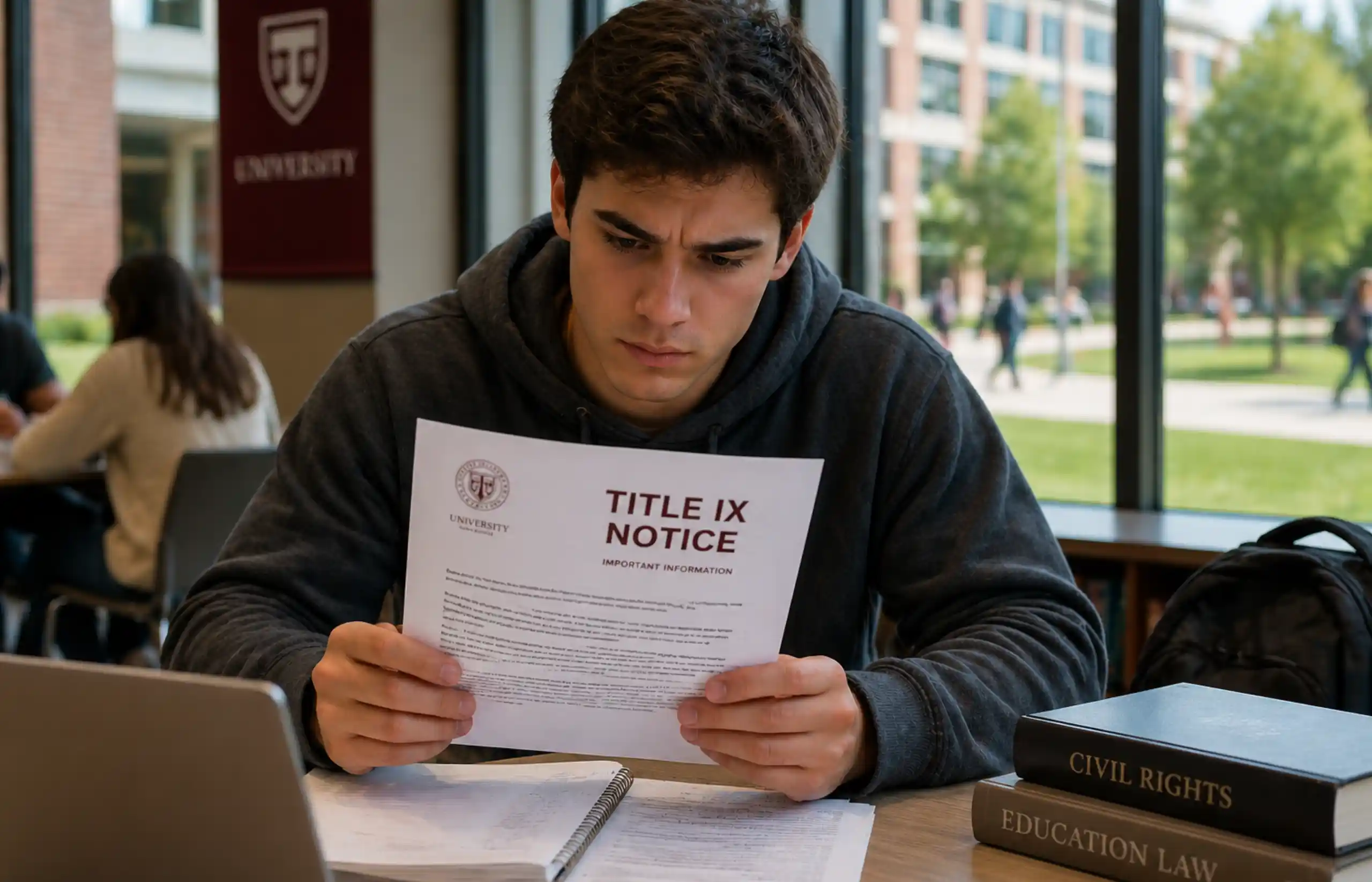
When a student receives an official notice from their university alleging a violation of Title IX, it can feel like everything suddenly narrows to a single, high-stakes moment. A Title IX violation is more than a simple school rule violation. It sits at the intersection of federal law, university policy, and your future because Title IX remains one of the most powerful tools for ensuring equity in the American educational landscape. It is a landmark civil rights law, officially cited as 20 U.S.C. §§ 1681–1688, designed to ensure equal access to education for everyone, regardless of sex.
Title IX Overview
Title IX is a federal law that prohibits sex-based discrimination in any educational program or activity that receives federal funding. While many people associate it with athletics, its reach is much broader and shapes how students experience nearly every part of campus life:
“No person in the United States shall, on the basis of sex, be excluded from participation in, be denied the benefits of, or be subjected to discrimination under any education program or activity receiving Federal financial assistance.”
In practice, this mandate, enforced by the Department of Education, applies to nearly every public and private university in the country. These protections extend well beyond the classroom. For example, official OCR oversight dictates how a university handles its recruitment strategies, how it ensures fairness in admissions processes, and manages the distribution of financial aid. If a school receives any federal funding, it is required to provide a safe, non-discriminatory environment.
The Scope of Protection
Understanding the basics of Title IX starts with recognizing that it protects students, faculty, and staff alike. It is not limited to traditional students. It also applies to anyone participating in an institutional “program or activity.”
- Athletic Equity: Ensuring equal opportunity in equipment, travel, and coaching.
- Admissions and Recruitment: Prohibiting bias in how prospective students are evaluated.
- Employment: Protecting university employees from sex-based harassment or disparate treatment.
- Pregnant and Parenting Students: Mandating that schools provide reasonable accommodations to ensure these students are not pushed out of their programs.
Why Compliance Matters to You
For a student or parent, compliance is not just a box for a university administrator to check. It represents the set of rules that the school must follow when they investigate you or your child. When the Department of Education updates its regulations, universities are required to adjust their grievance procedures to match.
Schools that fail to meet these standards risk losing federal funding. More importantly for students and families, a failure in compliance can lead to serious due process concerns, including situations where a student may be suspended or expelled without a fair opportunity to respond to the evidence. Understanding these obligations is often the first step toward holding a school accountable.
Forms of Discrimination Covered by Title IX
Many families first encounter Title IX during high-stakes misconduct cases, where the law functions as a broad layer of protection across nearly every aspect of the student experience. Under the currently reinstated 2020 standards, the definition of sexual harassment is intentionally narrow: conduct must be severe, pervasive, and objectively offensive to trigger a formal Title IX response.
- Sex-Based Harassment: This includes unwelcome conduct that meets the high “Davis” standard, or “quid pro quo” scenarios where an educational benefit is conditioned on sexual favors.
- Sexual Violence: This category covers the most serious allegations, including sexual assault, domestic violence, dating violence, and stalking. Schools are required to investigate these incidents when they occur within their program or activity.
- Pregnancy and Parental Status Discrimination: Schools must ensure that pregnancy does not result in a loss of educational access. This includes providing reasonable accommodations such as excused absences for medical necessity or private, non-bathroom spaces for breastfeeding and pumping.
- Unequal Athletic Opportunity: This is intended to ensure fairness in the student-athlete experience, covering everything from travel stipends and coaching quality to the provision of equipment and locker rooms.
- STEM Course Discrimination: Title IX prohibits the “steering” of students away from specific fields (such as science, technology, engineering, and math) based on gender stereotypes or sex-based bias.
- Retaliation: A cornerstone of the law is the prohibition of retaliation. If a student or parent reports a concern, the school is barred from taking adverse actions, such as academic penalties or disciplinary threats, against them for exercising their Title IX rights.
Title IX Compliance and Institutional Policies
While Title IX is a federal mandate, its real impact comes from how universities implement their own policies. The Department of Education’s Office for Civil Rights (OCR) is the primary agency responsible for ensuring schools follow federal law. Because the 2024 rules were vacated, most schools have had to revert their handbooks back to the 2020 standards to stay compliant.
Every institution must appoint at least one Title IX Coordinator. This person is the primary point of contact for all reports. It is also important to understand the difference between an informal resolution (a voluntary, mediated path that does not result in a finding of “responsibility”) and a formal hearing (the quasi-judicial process where a student’s future is often decided).
Under the current 2020 framework, a “Formal Complaint” remains a key legal document that the complainant or the Coordinator must sign so a formal investigation may begin.
The Typical Grievance Process
- Reporting and Filing a Complaint: Most cases begin with a formal written complaint. From there, the university must provide a Notice of Allegations outlining the claims.
- Supportive Measures: Even before any finding is made, schools must offer supportive measures. These are non-punitive (such as counseling or schedule changes) and must be offered to both parties to maintain educational access during the investigation.
- Investigation and Evidence Gathering: During this stage, investigators gather evidence and conduct interviews. Importantly, the 2020 rules require that all “directly related” evidence, not just what the school intends to use, be shared with both parties for review before the final report is finished.
- Hearing and Adjudication: For higher education, a live hearing is mandatory. At this stage, an advisor, who may be an attorney, conducts cross-examination of the other party and witnesses in real-time.
- Appeals: Once a decision is made, both parties have a right to appeal. Common grounds include a procedural error that affected the outcome, new evidence that was not previously available, or a conflict of interest by the Title IX staff.
Title IX Regulations and Enforcement History
Title IX has evolved significantly since it was enacted in 1972. When it was first passed, the law was relatively brief and did not clearly define how it would apply to athletics. The responsibility for crafting the initial regulations fell to the Department of Health, Education, and Welfare (HEW). During this formative period, the most significant legal battles focused on whether “revenue-producing sports” (like football and men’s basketball) should be exempt from the law’s reach.
| Amendment | Key Proposal | Outcome |
| Tower Amendment | Proposed by Senator John Tower to exempt revenue-producing sports from Title IX compliance, arguing they funded entire athletic departments. | Rejected: Congress determined that no program receiving federal funds could be exempt from anti-discrimination laws. |
| Javits Amendment | Proposed by Senator Jacob Javits as a compromise, directing HEW to create regulations that considered the “nature of particular sports.” | Adopted: This allowed for differences in equipment costs or travel needs while still mandating equal opportunity across the board. |
By 1979, HEW (which later evolved into the Department of Education) issued the “Policy Interpretation” that remains the backbone of athletic compliance today. This history shows that Title IX was never meant to remain static but instead functions as a living standard that adapts to the realities of campus life.
Controversy Surrounding OCR’s Three-Prong Test for Title IX Compliance
To determine whether a school is providing equal athletic opportunity, the Office for Civil Rights (OCR) utilizes a “Three-Prong Test.” An institution only needs to satisfy one of these three benchmarks to remain in compliance. However, the first prong, Substantial Proportionality, has become a major source of legal and public debate.
Proportionality requires that the percentage of male and female athletes be “substantially proportionate” to the percentage of male and female students enrolled at the university. While this approach is designed to protect the underrepresented sex, historically women, critics argue it can function like a quota system that does not always reflect the actual interests of the student body.
The Wrestling Room Dilemma: “Show, Don’t Tell”
To better understand how this works, consider a hypothetical university where the student body is 55% female and 45% male. If the current athletic participation is 60% male (largely due to a 100-man football roster), the school is out of compliance with Prong One.
To fix the ratio, the school has two choices: add new female teams or cut existing male teams. Because adding a new sport often requires significant funding for coaches, facilities, and scholarships, many schools choose what appears to be the more practical option. They may cut a men’s wrestling or swimming team, not because of a lack of interest or performance, but simply to “balance the books” for Title IX reporting. This often leads to “reverse discrimination” lawsuits from male athletes who lose their chance to compete despite having high interest and ability.
Pros vs. Cons of the Three-Prong Test
| Pros | Cons |
| Historical Correction: Forcefully addresses decades of exclusion where women were systematically denied athletic funding. | Potential for “Roster Management”: Can lead to the elimination of viable male sports teams purely to satisfy statistical ratios. |
| Maximizes Participation: Sets a high bar that encourages schools to proactively recruit and fund female athletes. | Ignores Natural Interest: Critics argue it assumes interest in sports is always 50/50, which may not reflect the actual student body’s desires. |
| Clear Benchmark: Provides a “safe harbor” for schools; if they hit the numbers, they are generally protected from litigation. | Reverse Discrimination Claims: Creates friction when male slots are reduced to match enrollment demographics rather than demand. |
Evolution of the Three-Prong Test and Guidance
The methodology for satisfying the Three-Prong Test has not remained static. Over the last two decades, the Department of Education has issued various “Clarifications” that changed how schools prove they are meeting student interests. The most contentious shift involved how a university determines if the “underrepresented sex” (usually women) is actually interested in more sports opportunities.
In 2005, a significant policy shift allowed schools to use web-based surveys to measure athletic interest. Under this guidance, if a school sent out an email survey and received a low response rate, they could point to a “lack of interest” as a legal justification for not adding more female sports teams. This shifted the approach from assuming interest based on enrollment numbers to “measuring interest” through active data collection.
However, this approach quickly faced backlash from advocates who argued that a non-response to an email should not be considered as a lack of interest in participating.
Consequently, in 2010, the Abandonment of the 2005 Survey Clarification occurred. The OCR issued a new memorandum stating that surveys could no longer be the sole coordinator of a school’s compliance. Instead, schools were once again required to look at multiple factors (such as participation in club sports or regional high school interests) to determine if they were truly meeting the needs of their students.
Resources and Complaint Procedures
If you believe a university has failed to uphold its Title IX obligations, whether through a botched investigation, a lack of supportive measures, or athletic inequity, timing is critical. There is a limited window to seek federal intervention.
The Office for Civil Rights (OCR) complaint process is the primary way to seek federal review. It is important to understand that there is a strict statute of limitations, meaning a formal complaint must generally be filed within 180 days of the last act of alleged discrimination. While the OCR can grant waivers for “good cause,” it is risky to rely on administrative leniency when your future is at stake.
What to Prepare for a Title IX Complaint
- Timeline of Events: Create a chronological log including the specific dates, times, and locations of all incidents or procedural failures.
- Witness Directory: Compile a list of names and contact information for anyone who observed the incidents or was involved in the school’s response.
- Documentary Evidence: Keep copies of every email, text message, and letter exchanged with the Title IX Coordinator or other administrators.
- The School’s “Rulebook”: Download a PDF of the specific Title IX policy and Student Code of Conduct that was in effect at the time of the incident (usually found in the Student Handbook).
Navigating a Title IX dispute can be an exhausting process, but understanding the procedural “tripwires” can prevent a school from dismissing your concerns on a technicality.
Secure Your Future with K Altman Law
Facing a Title IX investigation or advocating for fair treatment requires more than just understanding the rules. It often requires a thoughtful strategy. At K Altman Law, we help students and their families secure their rights nationwide. If you are facing life-altering allegations or procedural unfairness, you do not have to navigate the university’s disciplinary process alone. Contact us today to ensure your voice is heard and your future is protected.